Milt Drumm played three seasons in the minors and batted .330 with the Kearney Kapitalists in 1914. On this day in 1918, he lost his life on a French battlefield.
Clarence Milton “Milt” Drumm was born on October 28, 1889 in Bigelow, Kansas, a town in Marshall County that was located six and a half miles southwest of Frankfort. It was demolished during the construction of Tuttle Creek Lake in the early 1960s.
Drumm was educated in the public schools of Irving, Kansas and Grand Island, Nebraska. He later taught in the Grand Island Business College for one year, after which he engaged in farming. But Drumm also pursued a career in professional baseball.
In 1910, he signed with the Chapman club of the Class D Central Kansas League - a team that managed just 18 wins against 62 losses and finished the season 34-and-a-half games out of first place. The 20-year-old outfielder batted .236 with 29 hits in 123 at-bats. The Chapman team did not return in 1911 (in fact, the Central Kansas League disbanded half way through the season), and Drumm joined the Falls City Colts of the Class D MINK League for his sophomore year as a minor leaguer. In 94 games Drumm batted .302 as the Colts (1910 league champs) finished just two games behind the pennant winning Humbolt Infants.
In 1912 he was signed by the MINK League's Nebraska City Forresters. Batting a league best .341 with 65 runs scored and 23 stolen bases, the 22-year-old (playing first base for the Forresters) led the team to the league title, their first since the league was formed in 1910, during which time the Forresters had been the circuit’s basement team both seasons.
In 1913, Drumm spent spring training with the Monmouth Browns of the Class D Central League, but when the season started he was with the Waterloo Jays of the same league. Despite moments of greatness, including driving in the winning run two consecutive days in July, he never really got going and batted a disappointing .203 in 74 games in leftfield. Nevertheless, Drumm bounced back in style in 1914 with the Kearney Kapitalists of the Class D Nebraska State League batting .330 (second best in the league).
Despite this great comeback that was the end of Drumm’s professional baseball career. He probably returned to farming before entering the Second Officers’ Training Camp at Fort Sheridan, Illinois in 1917. Upon receipt of his commission Second Lieutenant Drumm was ordered overseas, sailing in January 1918. Upon arrival in France he received further training at an AEF school before being assigned to Company K of the 28th Infantry Regiment, 1st Division.
On May 28, 1918, the 28th Infantry Regiment captured the village of Cantigny from the German 18th Army, but 2/Lt. Drumm, who fearlessly led his platoon through shell and machine-gun fire, lost his life in the battle. He was 28 years old and was awarded the Distinguished Service Cross for bravery.
Six McDonnell, who had played high school baseball in Abilene, Kansas with Dwight Eisenhower and pitched against Drumm in 1913 for the Beatrice Milkskimmers, mentioned the ballplayer’s death in a letter to his fiancée while stationed at Fort Riley in 1918. "I read in yesterday’s Star where my old pal Milt Drumm (you've heard me speak of him) was killed in action in France . . . He sure was a swell fellow, honey, a real human."
Drumm was survived by his parents, Mr. and Mrs. William M. Drumm, and a brother, C. E. Drumm. He is buried at Greenwood Cemetery in Marshall County, Kansas.
Len Glica, a shortstop, played four seasons in the Brooklyn Dodgers' farm system before entering military service with the army. He died on this day in Korea in 1951.
Leonard G. “Len” Glica, the son of Henry and Caroline Glica, was born in Omaha, Nebraska on October 8, 1928. He played baseball at South High School in Omaha and signed with the Brooklyn Dodgers organization following graduation in 1947.
The right-handed hitting shortstop-second baseman was assigned to the Abilene Blue Sox of the Class C West Texas-New Mexico League where he batted .252 his rookie year with eight home runs. In September, after the regular season had finished and he was back home in Omaha, Glica was recruited to play for the Omaha Pros against the Satchel Paige All-Stars at American legion Field in Council Bluffs, Iowa. The Pros beat Paige’s All-Stars, 4-3, in 12 innings. Glica, playing second base, was 1-for-5 against Paige and Larry Napoleon.
Back with the Blue Sox in 1948, Glica spent spring training at Vero Beach, Florida, under the watchful eyes of such Brooklyn tutors as Fresco Thompson, Andy High, George Sisler and Pepper Martin. He batted .259 with 81 RBIs during the season and proved to be a fan favourite for his all-out style of play.
Glica was advanced to the Newport News Dodgers of the Class B Piedmont League in 1949. After playing 10 games and batting .258, he joined the Lancaster Red Roses of the Class B Interstate League, batting .261 in 126 games with six home runs. He remained with the Red Roses in 1950 and batted .253 with a career-high 10 home runs. On July 9 he had led Lancaster’s hit parade against the Hagerstown Braves with successive home runs in the third and fifth innings and a double in the sixth for his three for five, as the Red Roses walloped the Braves, 17-3.
"If I can't make the majors or high minors I would like to play out my string in pro baseball with Abilene," he confided to his friends in Omaha. "They play good ball down there and treat the players like heroes."
But Glica never had the opportunity to return to Abilene. He entered military service on November 30, 1950. Serving as a private with the 21st Infantry Regiment, 24th Infantry Division in Korea, he was killed in action on May 26, 1951 at Sanghongjong-ni, just four days after arriving in the war zone.
"Of the players whom I had the pleasure of associating with during my three years with the Abilene club,” Howard L. Green, former GM of the Blue Sox told the Abilene Reporter News after hearing of Glica’s death, “Len Glica and Joe Konitzki stand out as all-time favorites, not because of their playing talents altogether, but because of their character and devotion to the game of baseball. Both of them joined us during the 1947 season when the club was hopelessly out of the race but they hustled every inning as if a World Series were at stake. It was spirit like that which enabled us to average 1,200 [spectators per game] during the last three weeks of the season with nothing more to lure the customers than the promise of a ball game.
"Many of us thought they were headed for the majors. Joe may make it yet. He is now on the NDS list of the Minneapolis club in the American Association, having been drafted from the Dodger organization by the Giants [Konitzki peaked with 7 games for Minneapolis in 1950].
"If Len Glica isn't the first professional ball player killed in the Korean fighting, he is one of the first [he was, in fact, the second]. I think that the least that the Abilene club and their legion of wonderful supporters could do would be to set aside a night to the memory of Len Glica and to erect a memorial in the Abilene park in tribute to one of the finest competitors that ever represented Abilene in any sport. His life has ended far ahead of schedule, not through any fault of his, but the game of baseball will go on because of fellows like him who are called upon to fight so that we at home may continue to play.”
Len Glica is buried at Saint Johns Cemetery in Bellevue, Nebraska.
Roswell Higginbotham, star athlete of Texas A & M college and minor league ballplayer, served with the US Navy in WWII and lost his life on this day in 1943.
Roswell G. Higginbotham, known as “Little Hig,” first gained prominence as an outstanding backfield football player at Sherman High School, Texas, and went on to become a renowned football and baseball player at Texas A&M from 1917 to 1920. In his junior year, he pitched a no-hitter against the University of Texas, and was a football All-Southwest Conference back in 1919 and 1920.
Following in the footsteps of his brother Graly, Higginbotham left Texas A&M in 1920 to start a career in professional baseball.1 He was signed by the St. Louis Cardinals and attended spring training in 1921 at Orange, Texas, before being assigned to the Paris Snappers of the Class D Texas-Oklahoma League. Batting in the number two spot for fiery manager Earl “Red” Snapp, the young second baseman hit .301 and led the league with 53 stolen bases.
Higginbotham was back with the Snappers in 1922, and his brother Graly was in the same league as player/manager with the Sherman Red Sox. Higginbotham, who played shortstop that year, batted .315 in 96 games, leading the league with 36 doubles, as the Snappers clinched their second successive league title in a season that ended August 6, due to a railroad strike. One advantage of the early season finish was that Higginbotham was called up by the Fort Worth Panthers of the Class A Texas League. On August 25, 1922, he made his first appearance for the Panthers, playing shortstop and going hitless in two trips to the plate. He played one more game before the end of the season.

Higginbotham, however, turned his back on professional baseball after 1922. It was a time when there was often more money to be made with semi-pro teams, and he played with Thurber of the West Texas Oil Belt League during the summer, while coaching football at Austin College in the winter. In 1927, he accepted a position as freshman athletic coach at Texas A&M, and in 1928, aged 29, he made a surprising return to professional baseball. Red Snapp — his manager at Paris back in 1922 — was manager and part-owner of the San Angelo Red Snappers of the newly-formed Class D West Texas League, and encouraged Higginbotham to join the club. Batting in his familiar number two spot, but playing the outfield rather than the infield, he played 81 games and hit .286 with 10 home runs as the Red Snappers clinched the league title. They went on to defeat the Abilene Aces, three games to two, in the playoffs, before stumbling against the Palestine Pals of the Lone Star League in a dual championship playoff series. On September 2—in a game against the Pals that was to be one of Higginbotham’s last games in professional baseball — he hit three singles.
Higginbotham continued to coach freshman football and varsity baseball at Texas A&M, and produced two championship baseball teams including the school’s first ever Southwest Conference title in 1931, and another in 1934. In 1936, Southern Methodist University in Dallas began playing baseball again, after having dropped the sport during the early Depression years, and Higginbotham was hired to coach the team as well as the freshman football team.
He remained at Southern Methodist until April 1943, when, at the age of 44, he enlisted in the Navy. Lieutenant Junior Grade Higginbotham was stationed at Quonset Point Naval Air Station in Rhode Island, but two weeks after his arrival he underwent an emergency abdominal operation at the naval hospital. Higginbotham never recovered from the surgery. He died on May 23, 1943 and is buried at West Hill Cemetery in Sherman, Texas.
“I have met many of his former Southern Methodist players,” said his grandson Scott Higginbotham, “and have heard nothing but great things. They tell me he was strict, and extremely fair. All had the highest respect. I would have loved to have known him.”
Roswell Higginbotham was buried in Sherman, Texas, and survived by his wife, Margaret, and their son, Bobby. In 1973, he was elected to the Texas A&M Athletic Hall of Fame.
Lou Vann was a minor league infielder and star of many House of David teams during the 1930s. On this day in 1943, he lost his life in an accident at Camp Pendleton, while serving with the Marine Corps.
Lou Vann was born Luigi G. Varanese in Fall River, Massachusetts, at one time the leading cotton textile center in the United States. Lou - or Chet as he was known to his family - was one of ten children, and quit school after eighth grade to help support his family. His father Dominic would take young Lou to work with him at the cotton mill but Lou had little interest in being a weaver. He wanted to play baseball, and every opportunity he had he would grab a bat and get his brothers to pitch to him.
Vann was soon playing shortstop for the town team and began his minor league career in 1932, when he was signed by the New Haven Bulldogs of the Class A Eastern League. He batted .260 in 68 games with the Bulldogs and the following year he played briefly with the Harrisburg Senators of the Class A New York-Penn League and the New Bedford Whalers of the Class B New England League.
In 1934, seeing an opportunity to make more money than he could in the minors, Vann joined the House of David club, a famous barnstorming team with a religious background renowned for their long hair and beards. The team toured rural America playing amateur and semi-pro teams in exhibition games and even played against the Fall River All Stars with Lou's brother Pat playing shortstop and his youngest brother Bill as batboy. Vann remained with the House of David until being enticed to return to Organized Baseball in 1938 by the Sydney Steel Citians of the Class D Cape Breton Colliery League. Playing third base, he batted a respectable .271, but was back on the road with the House of David in 1939, becoming an integral part of their renowned, crowd pleasing "pepper game" and juggling act.
The House of David pepper game started like an ordinary game of pepper with three players tossing the ball to a batter, who bunted it back to them. Then the fielders started making false throwing motions and passing the ball back and forth between themselves, occasionally varying the procedure with a real toss to the batter, who often swung at the false pitches as well as the genuine ones. The players handling the ball increased the pace of their juggling until it was almost impossible for the spectators to follow the ball in its flight. They passed it over their shoulders, behind their backs, between their legs, and sometimes hurled their gloves instead of the ball, and occasionally even removed their shoes and tossed them to their companions. A slow motion variation was also introduced in the act.
Vann continued to play with the House of David through the summer of 1942, as well as playing winter ball in the Panama Canal Zone League with Cristobal. But in late 1942, at the age of 33, he enlisted with the Marines. Private First Class Varanese was stationed at Camp Pendleton, near San Diego, California, and died there in an accident on May 21, 1943. He was survived by his wife and young son who were living in Clearwater Beach, Florida.
Lou Vann is buried at the Fort Rosecrans National Cemetery in San Diego, California.
While more than 500 ballplayers have lost their lives in military service not all have been isolated incidents. On a number of occasions, a military baseball team, usually in transit from one place to another, has suffered fatalities. Here is the last of a seven part series describing some of these tragedies.
Bryan Air Force Base Bus Crash - 1955
On August 26, 1955, the Bryan Air Force Base baseball team was traveling by bus to a tournament at Barksdale Air Force Base in Shreveport, Louisiana. On the Bryan team was S/Sgt. Frederick A. LeClaire, who had pitched for the Goldsboro Cardinals in 1950. About three miles from Cushing, Texas, the bus blew a tire and plunged over a 30-foot embankment into a dry creek.
The injured managed to crawl out the windows or were helped out by rescuers. Trapped in the wreckage and fatally injured were A/1c Lloyd D. Buresh, a young ballplayer from Karlin, Missouri, and the driver of the bus, A/1c James C. Kirkpatrick of Buff City, Tennessee. Both died at a Nacogdoches hospital shortly afterwards.
Fred LeClaire was among the 13 others who were injured, four of them critically. However, there were no further fatalities.
While more than 500 ballplayers have lost their lives in military service not all have been isolated incidents. On a number of occasions, a military baseball team, usually in transit from one place to another, has suffered fatalities. Here is the sixth of a seven part series describing some of these tragedies.
Dutch Harbor Tragedy - 1947
In August 1947, the Dutch Harbor Army-Navy all-star softball team. (made up of seven Navy players from the Dutch Harbor Naval Operating Base, Alaska, and six Army players from nearby Fort Mears) were playing in an Alaska-wide tournament held at Kodiak on Kodiak Island. Team players included Y2C William R. Loftus (an amateur outfielder from Omaha, Nebraska), T/5 Delmar E. Nowak of Alpena, Michigan, T/5 Angus MacKay of Detroit and M/Sgt. Jacob R. Swander (a 12-year Army-man from East Altoona, Pennsylvania). Swander's 3-year-old son had been scheduled to make the trip with his father because the team's catcher had a broken thumb and couldn't play. At the last minute, the catcher decided to go and Swander's son lost his seat on the plane to Kodiak Island.
After the tournament finished, the 13-man team left Kodiak on August 6, at 0626 hours to make the 600-mile journey to Dutch Harbor aboard a U.S. Navy Consolidated PBY-5A Catalina flying boat. The PBY had a crew of five plus two other Navy passengers as well as the team. Pilots Lt (jg) William H. Zeigler and Lt (jg) Nave A. Fuliehan made their last report at 1045 hours about 150 miles from Dutch Harbor. After that, the PBY was never seen or heard from again.
A major search was conducted in the hope that the plane might have made a safe landing in sheltered waters along the route, with its radio damaged. Joining the search were transient aircraft and military planes from Fort Randall, Fort Richardson, Kodiak and Adak. The Navy cargo ship USS Sussex, enroute to Adak, was sent to the area to direct the surface operations, in which Coast Guard vessels and the Navy fleet tug USS Potawatomi participated.
All searches failed to locate anything that might indicate what happened to the PBY. A year later, with still no trace of the plane or passengers, all 20 passengers were declared dead. Ironically, many of the Navy personnel were due to have been discharged from service three weeks after the tournament. Some years later, wreckage that washed ashore at St. George Island, Alaska, is believed to have come from this plane.
Liston Anderson was an outstanding hockey and baseball player from Alberta, Canada, who lost his life in service with the Royal Canadian Air Force during World War II.
Liston Anderson, the son of William and Jean Anderson, was born in Strathaven, Lanarkshire in Scotland on May 4, 1911, and moved to Canada with his parents in July 1921.
He lived in Drumheller, Alberta and excelled as a local athlete. Anderson played twelve seasons with the Drumheller Miners in the Alberta Senior Hockey League. He was an outstanding defensiveman and a teammate of Tommy Anderson (no relation, but who, like Liston, was born in Scotland. Tommy Anderson went on to play professional hockey with the New York Americans of the National Hockey League). Liston Anderson received numerous offers to turn professional but chose instead to retain his job with Canadian Utilities.
Liston was also a prominent member of baseball, softball and soccer teams, pitching for the Drumheller Juniors and Drumheller Merchants. At nearby Rosedale’s annual Labor Day sports event on September 1, 1930, the Rosedale Seniors and Drumheller Juniors battled eight innings to a 6-6 tie in the baseball tournament final. Lorne Nichols of Rosedale and Liston Anderson of Drumheller had staged a hurling duel that eventually had to be called on account of darkness.
On May 29, 1935, Anderson played soccer for a select Alberta eleven, before a crowd of 3,500 in Calgary, against the touring stars of the Scottish Football Association. Losing to the Scots, 9-1, Anderson - the only Drumheller representative - scored the lone goal for the Canadians against his birth nation.
Anderson was married to the former Mary Malton of Empress, Alberta, and prior to his enlistment he was employed by Canadian Utilities. He joined the RCAF in May 1941, graduating as an observer and receiving his commission in May 1942 at Rivers, Manitoba. Flying Officer Anderson was assigned to submarine patrol work on the Canadian Atlantic Coast. He also served at Montreal with Ferry Command as observer-navigator in a Consolidated B-24 Liberator.
In February 1943, with Mary less than two months pregnant, Liston Anderson went overseas to Britain as a navigator/bomber. Aged 32, he was killed on active service aboard a bomber nicknamed "Trader Horn" on July 30, 1943.
Flying Officer Liston Anderson is buried at Llantwit Major Cemetery in the Vale of Glamorgan, South Wales. His son, Liston L. G. Anderson, was born on September 2, 1943, in Vancouver, British Columbia.
A star hurler at the University of Maryland, Springer played two seasons of minor league baseball before entering military service. His life ended on a battlefield in Germany in January 1945.
 Earl V. "Lefty" Springer was one of 11 children born to Mr. and Mrs. Harry C. Springer in Hagerstown, Maryland. He was an excellent left-handed pitcher at Hagerstown High School, and also played with Sharpsburg and the Hagerstown Cabbies in the local Washington County League. In 1937, he enrolled at the University of Maryland, where he excelled at baseball and soccer. Playing for coach H. Burton Shipley, Springer blanked Dartmouth, 10-0, on April 7, and beat Georgetown, 4-0, with a one-hitter to finish the season with an 8-1 record. But the highlight of the year was his no-hitter against Rutgers on April 1, 1939. "Zipping his fireball through the murky air with electrifying force," announced the Washington Post the following day, "and mixing with it a hook which darted in and around enemy bats with snakelike effect ... Earl Springer ... pitched a fiveinning, no-hit, no-run game yesterday as Maryland blanked Rutgers, 3-0.
In 1940, his senior year, he beat Duke, 6-1, giving up two hits, and hurled one-hitters against William & Mary and George Washington University. Keeping a close eye on Springer throughout the season was former major league infielder Fritz Maisel, who, in 1940, was a club director with the Baltimore Orioles of the Class AA International League. Springer pitched against the Orioles for the University of Maryland, and on several occasions during the early part of the season he went to Oriole Park to workout and talk to manager Tommy Thomas. "All of our players said Springer had plenty on the ball and was tough to hit," declared Thomas. "Pitchers, especially southpaws, with promise aren't easy to pick up these days, but I think Earl has a real chance of going places."

On May 27, 1940, Springer was signed by the Orioles and made 18 appearances over the season for a 1-2 record and 4.28 ERA. In 1941, he got off to a poor start, and on June 24, the Orioles optioned the 22-year-old to his hometown Hagerstown Owls of the Class B Interstate League. Springer helped the Owls to a second-place finish with a 5-8 record and 2.91 ERA in 14 appearances, and struck out 67 in 99 innings.
On January 15, 1942, Springer entered military service with the Army. He trained at Fort Knox, Kentucky, with the 7th Armored Infantry Battalion, 8th Armored Division, which later moved to Camp Polk, Louisiana. Sergeant Springer pitched a number of games for the division baseball team at Camp Polk, where one of his teammates was Emmett "Heinie" Mueller of the Philadelphia Phillies. In October 1944, the 8th Armored Division left Louisiana for Camp Kilmer, New Jersey, staging camp for troops being deployed to Europe. The division sailed on November 7, and arrived in England on November 22. They encamped at Tidworth Barracks and began six weeks of preparation for combat in Europe.
The division arrived in France at the beginning of 1945. In freezing winter conditions it advanced to Pont-a-Mousson in northeast France, arriving on January 12. After dark, on January 24, 1945, the 7th Armored Infantry Battalion moved north to its assembly point at Besch, Germany, in preparation for the next day's attack at Nennig. At 5:50 A.M. on January 25, the battalion launched an attack against strong enemy resistance. Springer was with Company B which attacked in M3 armor-plated half-track vehicles and suffered heavy casualties including the death of the company commander, Captain Grover Hermann, and the division's pitching ace, Sergeant Earl Springer.
Springer was buried at the Luxembourg American Cemetery, where, since 1945, local resident, Jean Folschette, has carried flowers to the grave of the man he never knew. Folschette "adopted" Springer's grave as an expression of gratitude to American soldiers who liberated his homeland from the grip of the Nazis. Folschette has corresponded with the Springer family for many years and regularly sends photos of the newly decorated grave. He has always refused offers from the family to pay for the flowers.
While more than 500 ballplayers have lost their lives in military service not all have been isolated incidents. On a number of occasions, a military baseball team, usually in transit from one place to another, has suffered fatalities. Here is the fifth of a seven part series describing some of these tragedies.
Negro 440th Port Company Team Plane Crash at Iwo Jima - 1946
During the afternoon of November 16, 1946, the 440th Port Company baseball team were flying back to Iwo Jima after having taken part in a tournament on Guam. Aboard the Curtiss C-46F Commando transport plane, piloted by Captain James C. Queen, were four other crew members, four US Army personnel and the 15 African-American members of the baseball team. Heavy cloud cover made the approach to Iwo Jima difficult and as the twin-engined plane approached Airfield No. 3 it was too high and missed the runway. The plane was still descending, however, and hit the water just off the island. It rapidly sank and all on board lost their lives.
The 440th Port Company baseball team:
Sgt. Joseph Bowers (Camden, SC)
T/4 Fred Brown (Ama, LA)
T/5 Robert L. Goins (Loganport, IN)
S/Sgt. Vivien L. Harris (Newark, NJ)
T/5 Emanuel M. Jackson (Occoquan, VA)
T/5 Jessie L. Glover (East St. Louis, IL)
T/5 Carnell Boyd (Hickory Valley, TN)
Pfc John T. Eatmon (Brooklyn, NY)
Pfc Jonathan Culbertson (Baltimore, MD)
Pfc Clarence W. Brown (New York, NY)
Sgt. Earnest Flowers (Chicago, IL)
Cpl. Harry L. Edmonds (Canton, MS)
Pfc L.C. Hollins (Ore City, TX)
Pfc William Jenkins, Jr. (South Charleston, OH)
Pfc Robert Hillman, Jr. (Thomaston, GA)
Crew members: Cptn. James C. Queen, 1/Lt. George Eisenhaur, 1/Lt. Richard G. Davis, Sgt. Earl C. Glass and Sgt. Stanley Brudney
Passengers: Pfc George A. Knoll, 2/Lt. Dwight K. Gilbert, WOJG Alfred J. Di Pietro and Pfc Arthur Brown
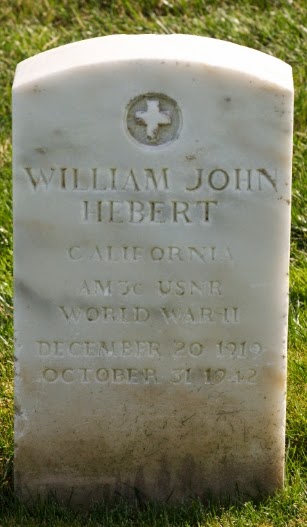
"As long as the game endures, it will bow in silent tribute to William John Hebert and others like him who have died in order that we might live in freedom."
The Sporting News, November 19, 1942
William J. "Billy" Hebert was born in Stockton, California on December 20, 1919 - the only child of Mr and Mrs George Hebert. The scrappy little infielder's diamond talents were first showcased with the Karl Ross post American Legion team. In 1936, his final year in American Legion ball he captained the team.
Hebert was a confident young man who believed in his abilities, and despite being only 16 he managed to convince San Francisco Seals' manager Lefty O'Doul to give him a tryout. Although Hebert was told to come back after he graduated from high school he made a favorable impression. "I saw a kid today who will make a star some day," Seals' publicist and former major league pitcher Walter Mails told the San Francisco Examiner after Hebert's tryout.
In the winter of 1937, Hebert traveled to San Francisco to play in the Seals Stadium League - a high level semi-pro league that played on Sundays and featured many players with professional experience. Hebert played second base and led off for the Dan P Maher club, a team sponsored by a local paint company. "I never saw a ball player who had such a dirty uniform," recalled Pete Deas, the team's shortstop, in an interview with baseball author Tony Salin. "He chewed tobacco and he'd spit tobacco juice on his hands and rub it on the front of his uniform. He always seemed to be sliding into a base or diving for a ground ball. He was one of the first guys I ever saw who would slide head-first into a base."
Hebert had an impressive season and in 1939 Cincinnati Reds' scout Bob Grogan signed him to a professional contract. He was to get $75 a month. The second baseman was assigned to the Ogden Reds of the Pioneer League where fellow middle-infielder Pete Deas from the Dan P Maher team would also play. "We were a good combination," Deas told Salin. "We worked well together - double plays, force plays, who would cover second on steals, things like that."
The home opener for Ogden was a 26-15 pounding of Salt Lake City. Hebert was 4-for-6 that day with a triple and a grand slam. He finished the year with a .302 batting average and 52 RBIs. "We had a friendly bet about who would have the highest batting average," Deas explained to Tony Salin. "I hit .300. So I paid him the money." The bet was for one dollar.
In 1940 Billy Hebert's contract was picked up by the Oakland Oaks. He played through spring training but was released before the season began. He did not play orgainized baseball in 1940 but found time to fall in love and get married. Hebert would be divorced before he entered military service.
Hebert was signed by the Merced Bears of the California League for the 1941 season. He had an exceptional year batting .328 in 130 games to lead the team. He led the league in double plays by second basemen and a bright future in baseball seemed to be on the horizon for the 21-year-old.
But shortly after the season ended Hebert entered military service. Like his father, Billy Hebert was a metalsmith, and this was a trade urgently needed by the armed forces. Hebert joined the Navy and trained at the Naval Air Station in Alameda, California before moving on to the Naval Air Station at Norfolk, Virginia. On July 14, 1942, Aviation Metalsmith Third Class (AM3C) Hebert left for the Pacific.
Guadalcanal is situated in the middle of the long Solomon Islands chain, northeast of Australia. The location of the Solomons made them key to Japanese plans for cutting off shipping between the United States and Australia. In 1942 the Japanese started occupying all of the islands, Guadalcanal was to be a major air base that would constantly threaten Allied shipping. The Allies, aware of the Japanese plans, decided to occupy Guadalcanal first and a muddy airstrip was captured from unarmed Japanese construction workers and renamed Henderson Field. The airfield would be the main focus of the Guadalcanal campaign.
AM3C Hebert was assigned to Henderson Field to help keep Naval airplanes serviceable. It was a dangerous place to be and repeatedly came under attack from the Japanese. When the battleships of the Imperial Japanese Navy, Kongo and Haruna, bombarded Henderson Field the night of October 13/14, their 14-inch shells all but destroyed the place and most of its airplanes. It was probably during this bombardment that Billy Hebert sustained the injuries from which he died on October 21, 1942.
"The Stockton, Cal., lad won't answer the umpire's call when it sounds again throughout the land," wrote The Sporting News on November 19. "But his memory will be cherished long in the annals of the game as the first to lay down his life so that both his country and the sport to which he dedicated himself might survive."
Many were saddened by the death of Hebert. "I was in Milne Bay, New Guinea, during the war when I heard he'd died," says his former double play partner Pete Deas. "Mother and Dad sent me the clipping. They figured I'd want to know. It was a shock. Very sad."
Frank Enright, a boyhood friend of Hebert's, was in North Africa serving as a private in the Army engineers when he heard the news. He sent a letter to the Stockton Record.
"Billy Hebert is the kind of man who should be remembered at home. I would like to see a plaque erected in his memory at Oak Park where he played so many Legion ball games. I am enclosing $10 to start the ball rolling. I would make it more only I haven't got it."
Another friend, Dario Bella, serving with the Navy at Farragut, Idaho, added $5 and soon the sports commission of the Stockton Chamber of Commerce organized a drive to erect a flagpole and bronze memorial tablet in centerfield at Oak Park in honor of Hebert. The Chamber encouraged $1 donations from friends to fund the $250 project. Within a few weeks they had more than $700.
On Memorial Day, May 30, 1943, in a moving ceremony, the flag was raised on a new flagpole in centerfield at the Oak Park ballpark to the sound of the Army Air Force band from Stockton Field. A bronze plaque, lovingly crafted by Billy's father, was unveiled at the base of the flagpole. "It will remain as a permanent record of a war hero's sacrifice," wrote John Peri, the Stockton Record's sports editor. The ceremony was followed by a game between Hebert's old American Legion post team, Karl Ross and the Bill Erwin post team from Oakland.

In 1951, Oak Park was renamed Billy Hebert Field. It burned down two years later and the new ball park, still called Billy Hebert Field, is the one that stands today in the grounds of Oak Park. But in 1967, when the fences were moved in, the memorial to Hebert was hidden - 24 years after Hebert's death no-one really noticed. Not until 1992, when two of Hebert's old friends, Joe Souza and Rab Longacre discovered the plaque overgrown by weeds did a new drive start to have it relocated. On November 11, that year, the plaque George Hebert had inscribed for his dead son was relocated in front of the grandstand.
Billy Hebert, the first professional baseball player to be killed in WWII, is buried at the Golden Gate National Cemetery in San Bruno, California.
While more than 500 ballplayers have lost their lives in military service not all have been isolated incidents. On a number of occasions, a military baseball team, usually in transit from one place to another, has suffered fatalities. Here is the fourth of a seven part series describing some of these tragedies.
Army Truck Hits Train in Belgium - 1945
Following the German surrender in May 1945, military baseball teams travelled across Europe entertaining troops. It was while traveling with the Army team near Brussels in Belgium that tragedy struck. The ball team was riding in the back of an Army truck when it struck a train. Among the injured was former minor league outfielder Sgt. Eugene L. Dellinger. Dellinger was badly burned and evacuated to the Veterans Hospital in Tuscaloosa, Alabama. He was transferred to the Northington General Hospital before succumbing to his injuries on January 31, 1946.
Robert "Bun" Troy was born in Germany and made just one appearance in the major leagues in 1912. Six years later he was on the battlefields of France, fighting and dying against the people from the country of his birth.
Robert G. “Bun” Troy, the son of Mr. and Mrs. August Troy, was born on August 27, 1888 in Wurzach (now Bad Wurzach), a small town in southern Germany. He grew up in McDonald, Pennsylvania, about 20 miles southwest of Pittsburgh. Pitching for the Knoxville County team in 1909, Troy had a tryout with the Philadelphia Phillies at the end of the season and was signed in October. For 1910, he was sent to the Johnstown Johnnies of the Class B Tri-State League but, despite winning his only game, he was released. "He had the speed and curves," explained the Sporting Life, "but lacked control, and acted too much like an amateur on the ball field." He returned to the Knoxville team before signing later in the year with the McKeesport Tubers of the Class C Ohio-Pennsylvania League.
At 6-foot-4, and probably the tallest player in the league, Troy had an unmemorable rookie campaign with the Tubers; in 17 games he had 6 wins against 8 losses. McKeesport didn’t field a team for 1911 and Troy, together with six other players, was sold to the Wheeling Stogies of the Class B Central League. He didn’t stay long in Wheeling and returned to the Ohio-Pennsylvania League with the Steubenville Stubs for a second forgettable season. In 20 appearances he again had 6 wins but this time suffered 11 defeats.
In 1912, 23-year-old Troy joined the Adrian Lions of the Class D Southern Michigan League and truly showed his ability as a pitcher. In 43 games he led the league with a 23-14 record (he also led the league with 268 strikeouts), helping the Lions clinch the league title. Detroit Tigers’ owner Frank Navin, who hailed from Adrian, had been keeping an eye on Troy and when the Lions’ season ended he bought Troy’s contract and called him up to Detroit.
On September 15, 1912, Robert Troy made his one and only major league appearance, starting for the Tigers against Washington. A good crowd was on hand at Detroit’s Navin Field that afternoon to see the great Walter Johnson of Washington whose record 16-game winning streak had been snapped a few days earlier. With 25-year-old Ty Cobb in centerfield for the Tigers, Troy matched Johnson pitch-for-pitch and shutout the Senators for six innings, protecting a 3-0 lead. But in the seventh inning he got in trouble. Against Troy and Ed Willett – helped by some sloppy fielding - six runs were put across before the inning was over and the game was called after eight innings because of darkness with the Senators up, 6-3 (Cobb, who batted .409 that season, was 0-for-3 on the day).
Hugely disappointed with losing his first big league start, attributing much of the blame to poor support during crucial innings, he jumped the team and returned home to McDonald.
Troy was assigned to the Chattanooga Lookouts of the Southern Association for 1913, who, in turn returned him to Adrian in the Southern Michigan League, where he enjoyed another outstanding season. Again he won 23 games in 43 appearances as the Lions finished in second place behind the Battle Creek Crickets.
In 1914, the 25-year-old was with the Pittsfield Electrics of the Class B Eastern Association where he was 19-13 in 36 games, leading the league with 212 strikeouts. That was Troy’s last season in organized baseball. He signed with Pittsfield for 1915, but the league didn’t make it to opening day. There are reports of Troy pitching semi-pro baseball for Worcester, Johnstown, Canonsburg and McKeesport over the next two seasons.
By 1917, Troy was in military service. As an army sergeant with the 80th Division he served in France, fighting against men from the country of his birth. He was fatally shot in the chest on the battlefield during the Meuse Argonne campaign. He died on October 7, 1918 at Evacuation Hospital Eight, a mobile hospital which, at the time was located in an area referred to as Petit Maujouy, midway between the hamlets of Ancemont and Senoncourt, six miles southeast of Verdun.
Sergeant Robert Troy was buried in France but his body was returned to the United States in 1921. Together with the remains of two other soldiers, he arrived in Monessen, Pennsylvania on August 5 and was transported to McDonald where his funeral was held at the First Presbyterian Church, followed by burial at Robinson's Run Cemetery in McDonald.
His .408 batting average for the Olean Oilers in 1940, made Herb Fash a fan-favorite. But a freak accident aboard an aircraft carrier would claim his life five years later.
Charles H. "Herb" Fash was born in East St. Louis, Illinois and was at East St. Louis Senior High School before enrolling at St. Louis University. For three years with the Billikens basketball team under coach Mike Nyikos (former Notre Dame star), Fash was an all-Missouri Valley selection and held the conference record for foul shots. Captaining the team in his senior year he played 20 games and scored 174 points.
At 6-foot-2, Fash was also an outstanding first baseman and broke into professional baseball with the St. Louis Cardinals’ organization immediately following graduation in 1936, joining the Union City Greyhounds of the Class D Kitty League. Fash batted .263 with 44 RBIs in 101 games in his rookie year and was brought up to the Columbus Red Birds of the Class AA American Association at the end of the season. He was assigned to the Decatur Commodores of the Class B Three-I League in 1937, where he played 26 games and batted .315, before being assigned to the Daytona Beach Islanders of the Class D Florida State League. In 25 games with the Islanders he batted .247.
Not surprisingly, Fash also played professional basketball during the winter of 1937–1938 with the traveling New York Shamrocks, a team that played every day of the week and twice on Sundays.
The big first baseman was with the Taft Cardinals of the newly formed Class D Texas Valley League in 1938, where he batted .345 with 14 home runs, an impressive 132 RBIs and a league-best 54 doubles to earn honorable mention on the league all-star selection.
With all teams failing to break even in 1938, the Texas Valley League disbanded after its inaugural season, and Fash split the 1939 season between the New Iberia Cardinals of the Class D Evangeline League and the Mobile Shippers of the Class B Southeastern League, batting .283 in 76 games for the Cardinals and .337 in 47 games for the Shippers.
Fash joined the Brooklyn Dodgers’ organization in 1940, and was with the Fayetteville Angels of the Class D Arkansas-Missouri League as a 24-year-old player-manager. He was batting .356 when the league collapsed on June 30, and the Dodgers sent him to the Olean Oilers of the Class D PONY League, where he became a fan-favorite with the upstate New York state team. His superb .408 batting average and excellent defensive play in 66 games helped lift the Oilers from the basement of the league to the top spot, and he was described by the Olean Times-Herald as “the most popular man to wear an Oiler uniform.” The Oilers went on to beat the Hamilton Red Wings, three games to one, in the playoffs and clinched the championship by defeating Batavia, four games to two.
Fash was sold to Elmira of the Class A Eastern League in September 1940 but was with Durham Bulls of the Class B Piedmont League for 1941. With the team on its way to a championship season; he was batting .253 when he broke his leg sliding across home plate in July.
Fash entered military service with the Navy the following year and served as a lieutenant junior grade on the aircraft carrier USS Hancock (CV-19) in the Pacific. In January 1945, the Hancock’s planes struck blows at Luzon in the Philippines and Formosa (now Taiwan).
On January 21, 1945, at around 1:30 P.M., a Grumman TBF Avenger torpedo bomber, returning from a sortie, made a routine landing on the Hancock, taxied and disintegrated in a blinding explosion as one of its 500-pound bombs detonated. Fifty-two sailors were killed — including Herb Fash. He was buried at sea and is remembered at the Manila American Cemetery in the Philippines.
While more than 500 ballplayers have lost their lives in military service not all have been isolated incidents. On a number of occasions, a military baseball team, usually in transit from one place to another, has suffered fatalities. Here is the third of a seven part series describing some of these tragedies.
Plane Crash at Foster Field, Texas - 1945
On August 9, 1945 – the Foster Field Falcons traveled to Childress Army Air Base in Texas, for a ballgame. The Falcons won the contest and five of the players – Cpl. Peter J. Zarrilla, Sgt. H. Duard Lawson (an amateur first baseman from Princeton, Texas), 1/Lt. Harold G. Phillips (a semi-pro catcher from Georgia), S/Sgt. Chester V. Seipp (a semi-pro shortstop from Pasadena, Maryland) and Cpl. Lester O. Clotiaux (a Refinery League catcher from Nederland, Texas), along with 2/Lt. Peter R. Davis (a veteran transport pilot with 1,500 hours to his credit) flew back to Foster Field in a twin-engine Beechcraft AT-7C airplane. On the return journey the plane crashed and burst into flames near Smiley, 60 miles east of San Antonio, Texas. All six men were killed.
Jim Ferguson was a 6-foot-6 right-hander who pitched just a handful of games in the minors before military service intervened. Ambushed by North Korean forces, his body has never been recovered.

James T. Ferguson and his twin sister, Joan, were born in Seattle, Washington on April 26, 1931. The son of Mr. and Mrs. James W. Ferguson, he attended West Seattle High School where he was outstanding in baseball and football, and all-city in basketball. Ferguson graduated in 1950 and was signed by New York Giants’ scout Dutch Reuther on June 11th of that year. He was originally assigned to the Idaho Falls Russets of the Class C Pioneer League but did not play and joined the Lawton Giants of the Class D Sooner State League. Under the watchful eye of former major league infielder Louis Brower, the 6-foot-6, 195-pound, right-hander made five appearances for the Giants. What may well have been his professional debut on July 2, was a humiliating 32-9 loss to the Ada Herefords, in which Ferguson was ejected from the game with two out in the first inning for arguing with the plate umpire. He also made a relief appearance against the Chickasha Chiefs on July 18, a complete game loss against Chickasha on July 23 and hurled the first inning of a 34-16 revenge win over Ada on August 30. Whilst exact pitching records for Ferguson are unavailable, I estimate he finished the year with a 0-2 won-loss record.
Ferguson was due to report to the Idaho Falls Russets for spring training in 1951, but was called for military service on January 18. Assigned by the army to Fort Lawton, near his home in Seattle, he pitched the camp baseball team to 16 straight victories during the summer.
Ferguson arrived in Korea in October 1951 and served with Company E, 2nd Battalion, 160th Infantry Regiment of the 40th Infantry Division. On June 17, 1952, only three weeks before he was to have been rotated home, Corporal Ferguson was with a patrol in Kumsong that was ambushed by North Korean forces. He was listed as Missing in Action and presumed dead on January 27, 1954. The 21-year-old’s remains were never recovered.
On May 8, 1954, Colonel Bernard A. Tormey, commanding officer at Fort Lawton, presented James W. Ferguson with his son’s Silver Star for extreme gallantry. Ferguson was also awarded the Purple Heart, the Combat Infantryman's Badge, the Korean Service Medal, the United Nations Service Medal, the National Defense Service Medal, the Korean Presidential Unit Citation and the Republic of Korea War Service Medal. James Ferguson’s name is inscribed on the Courts of the Missing at the Honolulu Memorial.
Harmon J. Bove, Jr., a friend, a man, and a great marine who died fighting for America.
Gene R. Dark – The Brutality of War: A Memoir of Vietnam
Harmon J. Bove, Jr., was born on March 13, 1950 in Burlington, Vermont. At 5-foot-10 and 195 pounds, he was a standout athlete at Burlington High School, playing football as a linebacker on defense and as an all-state fullback on offense. In baseball – also all-state - he was a sensation behind the plate throwing out a succession of would-be base stealers with his rifle arm. In 1968, he was named to the Vermont Shrine football team for the 15th Annual Shrine Maple Sugar Bowl Game.
Bove turned down the opportunity to play football at Washburn University (KS) to sign with the Houston Astros upon graduation in 1968. The Astros sent the 18-year-old catcher to the Covington Astros of the Rookie Class Appalachian League. Under the guidance of veteran Cuban manager Tony Pacheco, and playing alongside future big leaguers Cesar Cedeno, Rich Chiles, Bill Greif, Buddy Harris and Juan Jimenez, Bove appeared in 24 games and mustered six hits in 34 at-bats for a .176 batting average. The summer of 1968 was to be Bove’s last on the professional ballfield. The United States was in the midst of the Vietnam War and Bove enlisted with the Marine Corps.
“At Camp Geiger [Jacksonville, NC), I met Harmon Bove,” recalled Gene Dark (son of all-star shortstop and major league manager Alvin Dark), in The Brutality of War: A Memoir of Vietnam. “I had seen him at Parris Island a few times. He was the platoon guide for Platoon 102, our sister company. He had the cocky tough-as-nails walk and the stocky, muscular build to go along with his title of guide. Bove was impressive looking. He was about five feet, eight inches or so and two hundred pounds and looked like he could bench press twice his weight or more. His shoulders were broad and his bulging neck muscles made it difficult to determine where his neck ended and began.
“Because of Bove’s interest in sports, I told him who my father was. He loved baseball, so the stories of growing up as Alvin dark’s son fascinated him. We would talk about baseball for hours after the day of training was done, and we eventually grew to be inseparable.
“One evening, I asked Bove why he had joined the Marines.
““Well, Dark,” he said, reflecting, “I did a very stupid thing. I had a few strings pulled for me and went to sign up with the National Guard. When I went to enlist, to become one of those ninety-day wonders, this egotistical major in the Vermont Guard told me, ‘Cowards like you turn my stomach. Young men are dying on the battlefield of Vietnam, fighting for America, while you lie around taking it easy feeding off this great land. Well, the idiot made me so mad that I joined the marines the next day. He glanced at me with a big grin, ‘How’s that for being an imbecile?””
When training was completed at Camp Geiger, Bove was given 30 days leave to visit his family before reporting to Camp Pendleton, California. During 20 days staging at Camp Pendleton, Bove and his fellow Marines received shots, started on malaria pills, sat through first aid lectures and generally prepared for life in Vietnam.
During this time, Gene Dark, was feeling pretty concerned about what he was going to face in Vietnam and asked Bove how he felt he would cope. “How do you think you are going to react when those gooks start shooting at you, Bove? Do you think you will be brave or will you hide behind anything you can find, shaking and scared out of your mind?”
“Brave?” Bove asked. “Nope, I’ll be scared to death I’m sure, but I’ll do my job.”
It was at this time that Bove confessed his true fears. “The Nam is no joke,” he said to Dark. “It’s the real deal. It’s blood and guts and dying, man, and I ain’t going to make it back. I know I’m going to die in that lousy stinking country. I can just feel it.
“I see myself blown to bits,” he continued, “lying in a rice paddy, sweating and dying under the steamy hot sun of Vietnam. I can see it as clear as day when I close my eyes, Dark.”
After Camp Pendleton, Bove flew to Okinawa, Japan and was assigned to E Company, Second Battalion, Fifth Marines of the First Marine Division. Gene Dark was assigned to F Company.
After arriving in Da Nang, Vietnam, Bove and Dark took a helicopter to An Hoa to join their respective companies. “Do me a favor, you dumb grunt,” Corporal Bove said to Dark, as they shook hands, perhaps, for the last time. “Try to keep your rear-end in one piece. I don’t want to have to go visit your mother.”
“Try to keep yourself together, too,” replied Dark. “I know how hard that’s going to be for a stupid catcher.”
Bove’s Vietnam tour started July 4, 1969, and he served as an anti-tank assaultman. After a month he contracted malaria during Operation Durham Peak in the Que Son Montains. He was evacuated to a military hospital in Da Nang for recuperation but was soon back in the frontline.
On March 3, 1970, while out on patrol in Quang Nam Province, Corporal Bove stepped on a booby trap and suffered multiple fragmentation wounds. He was flown to a hospital in Da Nang, where he died the following day. He would have turned 20 in nine days.
“He was as strong as an ox, defiant, proud, tough, and so full of life,” recalled Gene Dark. “Nothing could ever get him down. Every time I got dejected, he had been there to cheer me up. Now he was gone.”
Harmon Bove is buried at Lakeview Cemetery, which is located alongside Burlington High School’s baseball and football field. His headstone, made by the stonemasons in Burlington, resembles a bench in the dugout, with a baseball and glove etched into the stone.
In 1990, the Harmon Bove Memorial Scholarship was established by the Vermont Sportswriters and Sportscasters Association.
The Bove family baseball spirit was kept alive by his older brother, Perry Bove, who was the head baseball coach at St. Michael's College (VT) from 1990 to 2005.
In March 2004, the following touching tribute was posted on the Vietnam Veterans Memorial Fund Virtual Wall by retired US Navy Radioman Donald Lytle:
I want to thank you Harmon Joseph Bove, Jr., for your courageous and valiant service, faithful contribution, and your most holy sacrifice given to this great country of ours!
Your Spirit is alive--and strong, therefore Marine, you shall never be forgotten, nor has your death been in vain!
Again, although we never met personally, thank you Corporal Harmon J. Bove, Jr., for a job well done!
It's Heroes like you, that made it possible for us to return and lead full and free lives.
REST IN ETERNAL PEACE MY MARINE FRIEND
While more than 500 ballplayers have lost their lives in military service not all have been isolated incidents. On a number of occasions, a military baseball team, usually in transit from one place to another, has suffered fatalities. Here is the second of a seven part series describing some of these tragedies.
Plane Crash at Victorville, California - 1943
On Sunday, May 23, 1943, the Victorville Army Air Base Bombers were scheduled to play a game in Las Vegas, and a number of the players were going to fly there. The short flight was to end in tragedy.

The official story released by the military claimed a Beechcraft AT-11 Kansan was struck by another AT-11 while on a bombardier training exercise. One plane crashed at Silver Lake, California, about 90 miles from Victorville, killing all on board, while the other plane, which suffered minimal damage, managed to land safely back at the airfield. In truth, the two planes were heading to Las Vegas for the ball game and the pilots were playing games with each other when one plane cut the tail off the other. On board the crippled AT-11 were 2/Lt. Harold B. “Hal” Dobson, a former minor league pitcher, Sgt. John A. Lowry, a semi-pro ballplayer from Arnold, Pennsylvania, and Sgt. William E. Thomas, a semi-pro player from Pittsburgh. They were all killed along with the pilot, 2/Lt. William S. Barnes.
1/Lt. Matt Lynch, former Duke University catcher, served three tours in Iraq with the Marine Corps. He lost his life on that final tour.
Matthew D. "Matt" Lynch, the son of Bill and Angela Lynch, was born in Jericho, New York, on May 10, 1979. He attended Jericho High School where he was an outstanding swimmer and baseball player. He was All-County swimmer three years in a row, and a County champion in two events each of his last two years. As a catcher on the baseball team he was All-County his last two years in high school, nominated for the “Diamond Award,” as one of the best players in Nassau County; and as a senior, he tied for the home run record.
Lynch graduated from high school in 1997 and won a scholarship to Duke University where he continued to excel as an athlete. He was the swim team's “Rookie of the Year,” and became a mainstay of that team. He was also a catcher on the Blue Devils baseball team for two years. In 1999, as a back-up catcher, he played in 10 games, started two and finished with three hits and two RBIs for a .273 average. In 2000, Lynch played in 30 games, starting 13 and amassing 13 hits, seven RBIs and a .217 batting average.
After graduating from Duke in 2001, Lynch joined the Marine Corps, and enrolled in OCS (Officer Candidate School) at Quantico, Virginia. His brother, Tim, was already a Marine, and his father had served in the Marine Corps in the 1960s.
Lynch completed officers training in December 2002 and was commissioned as a 2nd lieutenant. He served with 1st Marine Division, 1 Marine Expeditionary Force based at Camp Pendleton, California. He was deployed to Iraq in March 2003. He returned to Camp Pendleton in August, but was sent back in March 2004. Returning in July he volunteered for a third tour on August 31.
On October 31, 2004, near Ramadi, the capital of the Al Anbar province of Iraq, First Lieutenant Lynch, serving as a platoon leader with Weapons Company of the 2nd Battalion, 5th Marine Regiment, died from injuries suffered from a roadside bomb explosion the day before.
During his military career, he was awarded the Navy and Marine Corps Achievement Medal, the National Defense Service Medal and the Global War on Terrorism Expeditionary Medal.
Matt Lynch is buried at Long Island National Cemetery in Farmingdale, New York.
"Matt was a sucker for a high, inside pitch," recalls his dad. "Not only could he not hit it....he couldn't resist it. When they named the new electronic swim scoreboard in the Duke pool for Matt in 2006, I told those assembled about the many times I pitched batting practice to Matt, saying: 'Here it comes kid,...high...inside...and you won't even SMELL it!' I'd throw, he'd miss, pound the plate with his bat and say, 'Lemme have it again, Dad'...I would, ...same result.
"Even in heaven, St. Peter himself will not be able to get Matt to lay off that pitch."
In his honor, the 1st Lt. Matthew D. Lynch Memorial Scholarship Fund has been established at Duke University to provide whole or partial scholarships to undergraduate students.